


Beauty Sleep. It is a real thing.
While you sleep, your skin shifts from defence to recovery. Cell renewal and blood flow increase, while skin also loses more water than it does by day. That explains why some products do their best work in the evening, and why sleep itself shows on your skin. In November, as daylight shrinks and sleep often suffers, that night shift gets harder.
"Beauty sleep" might sound like something your grandmother made up. She had a point.
Your skin has a clock
Almost every cell in the body follows a daily rhythm, and skin cells are no exception. The body's master clock in the brain is set mainly by daylight reaching your eyes in the morning. That clock keeps the others in step, including those in your skin.
YOUR SKIN’S 24-HOUR CLOCK
Defend by day, repair by night.
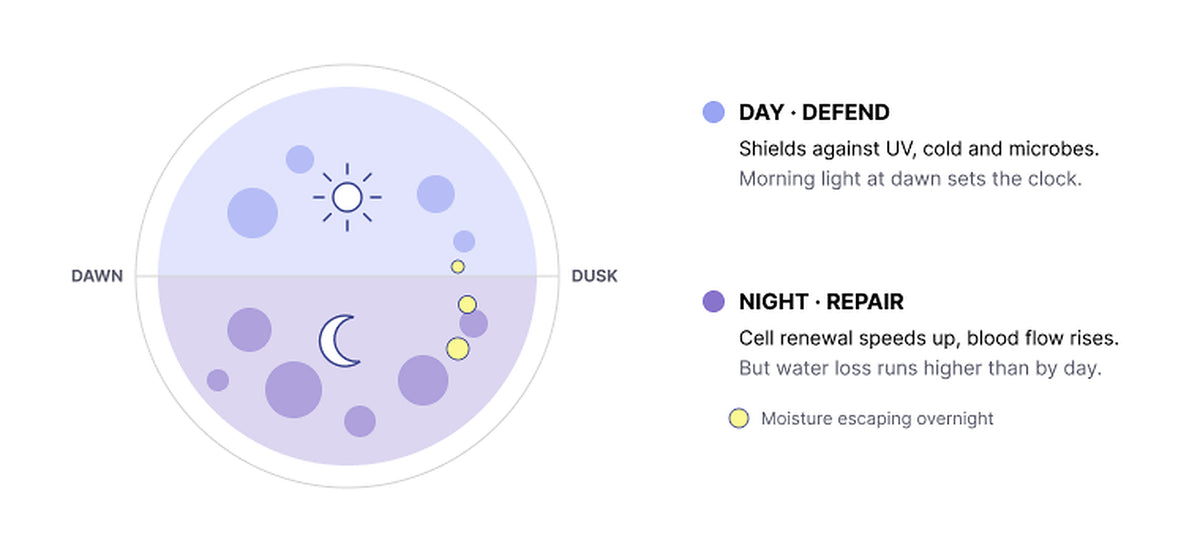
By day, skin is geared towards protecting itself from UV, cold, pollution and microbes. By night the focus shifts to recovery: cells in the outer layer divide more and blood flow to the skin rises. At the same time, measurements show skin loses more water in the evening and overnight than during the day. So it's recovering while it's most at risk of drying out.
Your skin's day in three phases
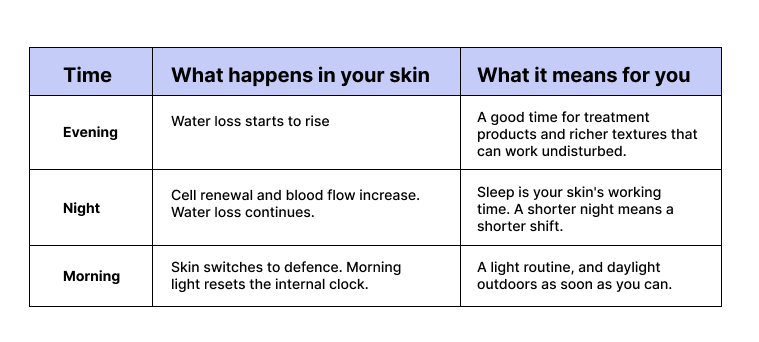
Why November makes the night shift harder
Less light, weaker clock. In Stockholm, daylight shrinks by just over two hours during November. Without a strong morning light signal, the body clock drifts, which most people feel as heavy mornings and broken sleep.
NOVEMBER’S VANISHING LIGHT
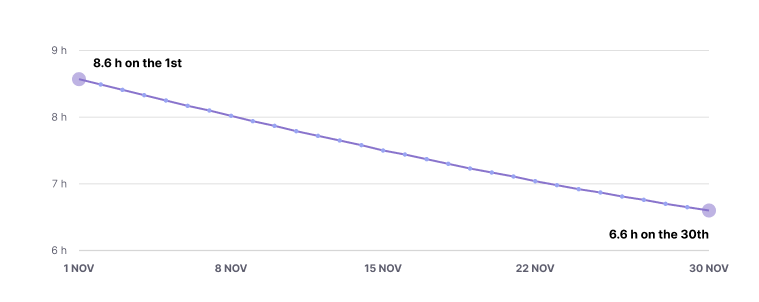
Calculated for Stockholm (59.3° N), sunrise to sunset, November 2026.
That's about four minutes of light gone every day, which is why a morning walk matters more in November than in any other month.
Shorter, poorer sleep. In one study, women who slept poorly recovered their skin barrier more slowly than good sleepers and were less satisfied with how their skin looked. In another, 24 women had their sleep restricted for two nights; several skin measurements worsened and their faces were rated as looking more tired. Both studies are small, but they point the same way.
Stress. Late November is deadline season. Psychological stress has been linked in studies to slower skin barrier recovery, partly through the stress hormone cortisol.
Julbord season. Late dinners and alcohol often help you fall asleep faster but fragment the second half of the night, right in the recovery window.
"In the darker months my own cheeks easily get extra dry and sensitive. That's when I add a nourishing face oil like ABR Face Oil, or Purito's sleeping pack, to my evening routine for a little extra care." – Linda, Skin Therapist at Know To Glow
Why some products belong in your evening routine
Night has three practical advantages: no sun, no make-up and several hours when products can sit undisturbed.
-
Retinoids
Retinal and other vitamin A derivatives break down in light, and they're used while skin is geared towards renewal. That's why they belong in the evening. Geek & Gorgeous A-Game 5, with 0.05% retinal, is a gentle way to start. Use it two to three evenings a week at first, and wear sunscreen the next morning.
-
Exfoliating acids
Use them in the evening so your skin gets a night's rest before facing daylight and cold. If you're new to them, don't combine acids and retinoids on the same night. We recommend Juvy Skin Overachiever Peptide Peel Pads
-
Richer textures
What feels too heavy under make-up works well overnight, when water loss is highest. Pyunkang Yul ATO Cream Blue Label goes on as the last step. For something lighter, Purito Luminous Ceramide Moisturiser is in the same range.
-
Soothing serums
If your skin feels irritated after a long day, a fragrance-free serum such as Pyunkang Yul Moisture Ampoule fits in before your cream.
Looking for a complete winter routine for dry, sensitive skin? It's in Skin barrier repair: November routine.
Five sleep habits your skin will notice
-
1. Get morning light.
Spend 10–20 minutes outdoors early in the day, even under grey skies. Outdoor light is far brighter than indoor lighting and is the strongest signal your body clock gets.
-
2. Dim the evening.
Bright lights and screens late at night can make it harder to fall asleep. It's the lost sleep, rather than the screen light itself, that affects your skin.
-
3. Do your routine a little before bed
Products have time to settle, and less ends up on the pillowcase.
-
4. Think about how you sleep
Sleeping on your side or front presses your face into the pillow for hours every night. Researchers have described "sleep wrinkles" that form this way. Sleeping on your back, or at least switching sides, reduces the pressure.
-
5. Change your pillowcase regularly
ideally once or twice a week if you're breakout-prone. It's a simple hygiene habit.
Frequently asked questions
Is my evening routine more important than my morning one?
They do different jobs. Mornings are about protection, evenings about recovery and treatment. Retinoids belong at night, sunscreen in the morning.
Does a silk pillowcase help?
Silk may feel gentler on skin, but there are no good studies showing it prevents wrinkles. How you sleep probably matters more.
Does my phone screen damage my skin at night?
The amount of light from a phone is tiny compared with daylight. Its biggest effect on your skin is likely through your sleep.
Why is my face puffy in the morning?
When you lie down, fluid collects more easily in the face, especially after salty food or alcohol. It usually settles during the morning. A slightly higher pillow helps some people.
When sleep is the problem
If you're sleeping badly for weeks, feeling persistently low, or exhausted however much you rest, talk to a healthcare professional (in Sweden, 1177.se). The dark season affects mood and sleep for many people in the Nordics, and your wellbeing comes first.

Sources
- Yosipovitch G et al. Time-dependent variations of the skin barrier function in humans. Acta Derm Venereol. 1998;78(1):1–4.
- Matsui MS et al. Biological rhythms in the skin. Int J Mol Sci. 2016;17(6):801.
- Oyetakin-White P et al. Does poor sleep quality affect skin ageing? Clin Exp Dermatol. 2015;40(1):17–22. Link
- Léger D et al. "You look sleepy…" The impact of sleep restriction on skin parameters and facial appearance of 24 women. 2022. PubMed
- Altemus M et al. Stress-induced changes in skin barrier function in healthy women. J Invest Dermatol. 2001;117(2):309–317.
- Ebrahim IO et al. Alcohol and sleep I: effects on normal sleep. Alcohol Clin Exp Res. 2013;37(4):539–549.
- Anson G, Kane MA, Lambros V. Sleep wrinkles: facial aging and facial distortion during sleep. Aesthet Surg J. 2016;36(8):931–940.


